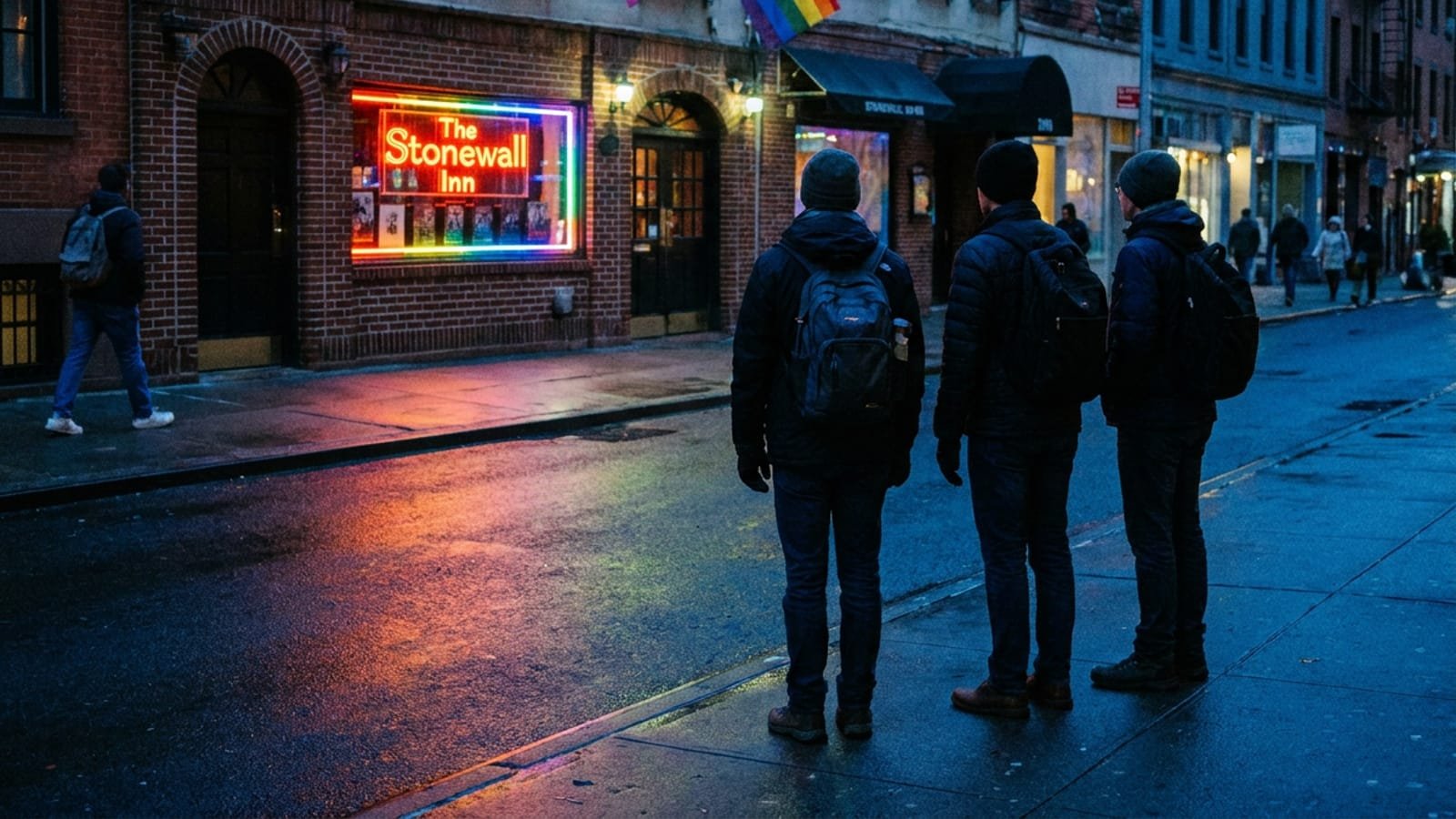
The honest answer to Hop On Hop Off vs NYC Subway: they aren't the same product. Hop on hop off is sightseeing — narrated routes past iconic landmarks at touring pace, designed for visitors. The NYC Subway is transit — fastest possible point-to-point movement at the price of zero narration and underground darkness. The Hop On Hop Off vs NYC Subway decision really comes down to: do you want to see things from a moving platform, or get somewhere fast and then walk?
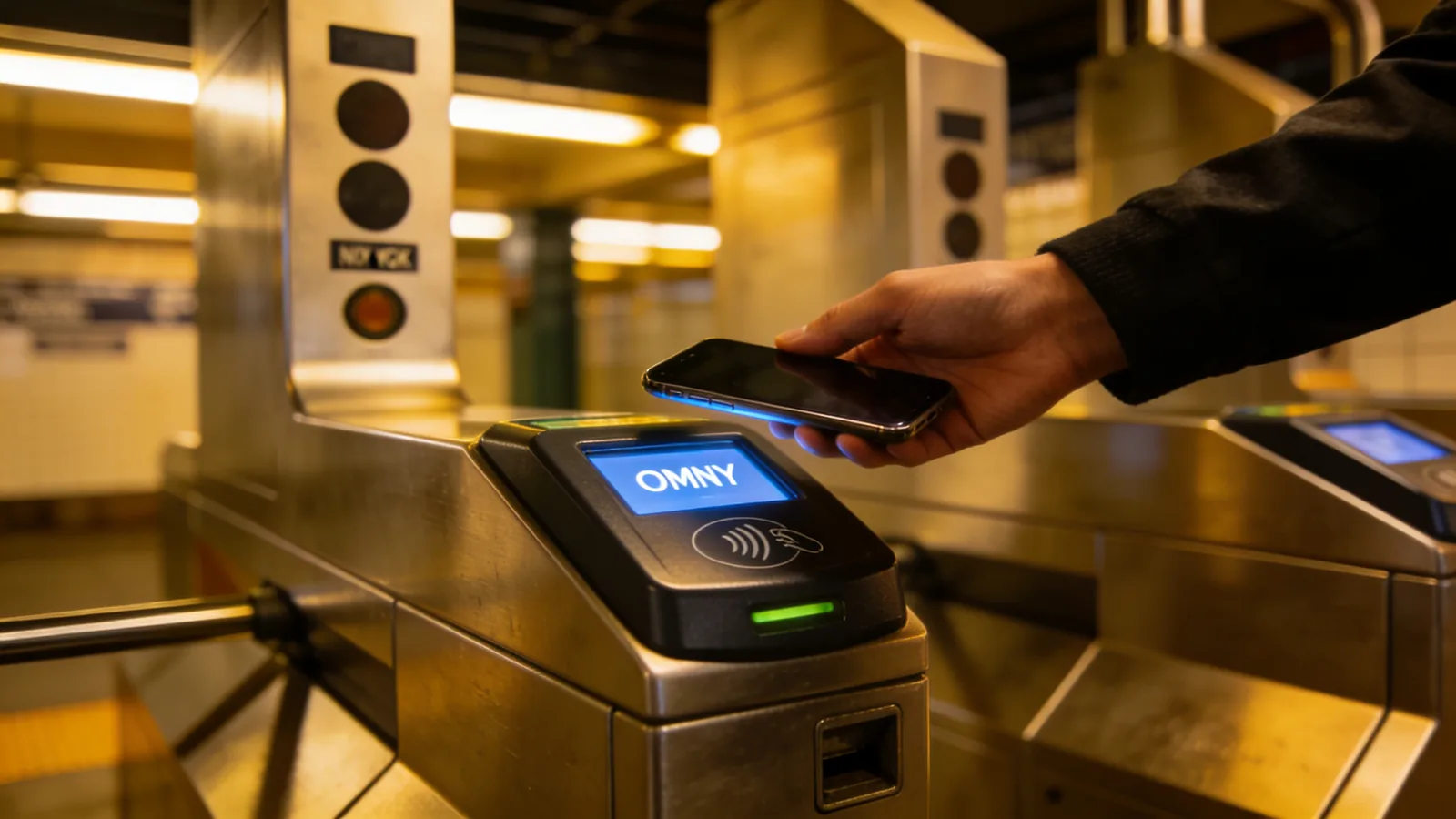
Per MTA, OMNY (the contactless tap-to-pay system) now works at every NYC subway station, every MTA bus, and Staten Island Railway — making subway access easier for visitors than ever. The subway is dramatically faster than the bus for crossing Manhattan; the bus is dramatically more scenic for first-time visitors who want to see what they're crossing through. Both have a place in a well-planned NYC trip.
Looking to book either side? See City Tours' Hop On and Hop Off Bus is the bus product (subway tickets sold by MTA, not us). And for a guided alternative that uses the subway between distant stops + walking pace within neighborhoods + a real human guide, see the See City Tours NYC Icons Experience — combining transit efficiency with depth.
Quick answer: Hop On Hop Off vs NYC Subway
- Pick Hop On Hop Off if: first-time visitor + want narrated sightseeing + need rest between stops + don't mind slow pace
- Pick NYC Subway if: getting from point A to point B fast + know where you're going + budget tight + comfortable with crowds and stairs
- Pick both: standard NYC trip uses subway for transit + bus for orientation. They're complementary, not competing.
- The honest insight: The Subway is transit; hop on hop off is touring. Don't ask "which is better at transit" or "which is better at sightseeing" — ask "what do I actually need right now."
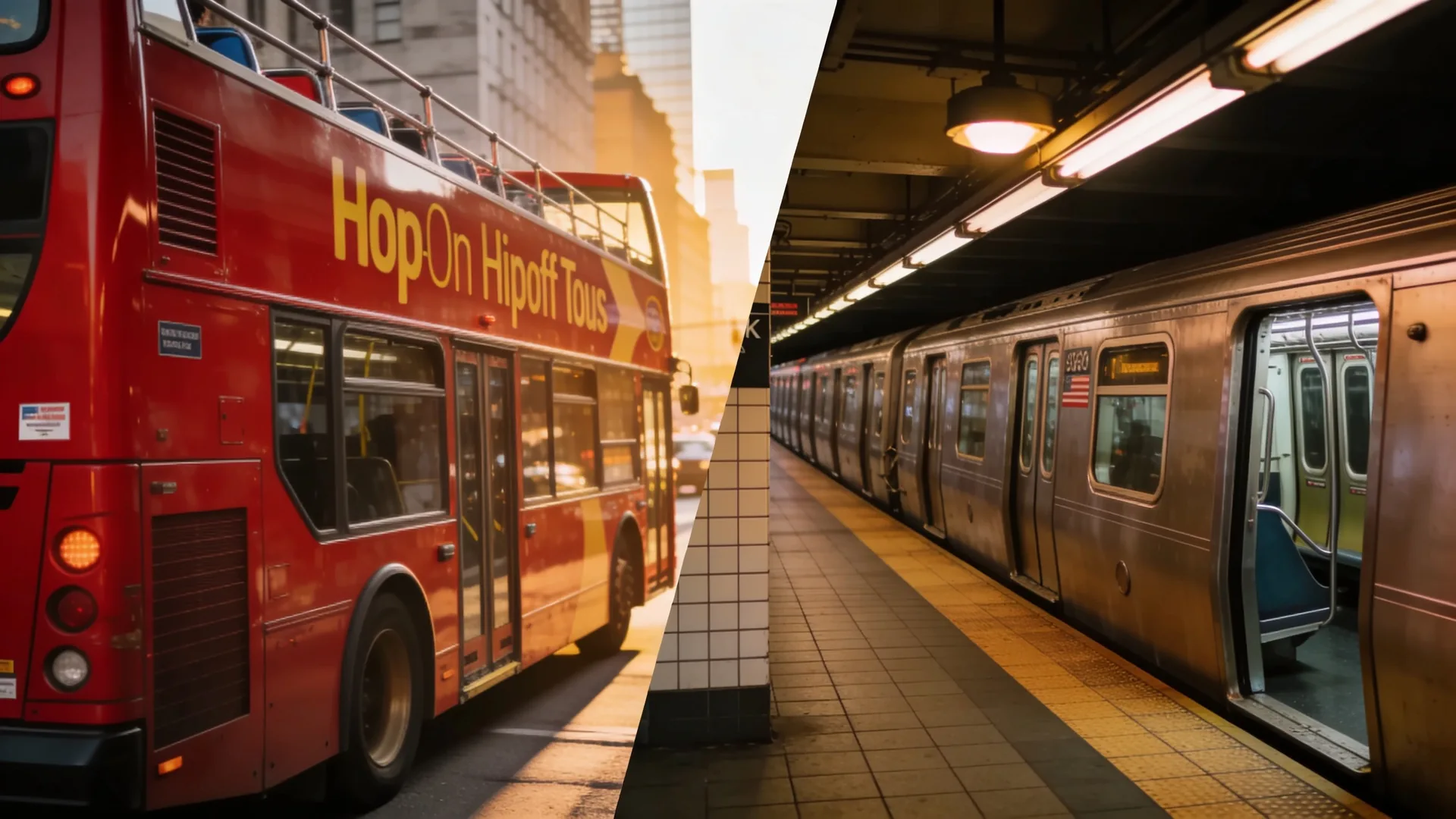
Hop On Hop Off vs NYC Subway — comparison table
| Category | Winner | Why |
|---|---|---|
| Point-to-point speed | NYC Subway | 35-45 min Manhattan end-to-end on 1/2/3. Bus is 90+ min for same. |
| Narrated sightseeing | Hop On Hop Off | Audio + live-guide narration en route. Subway is silent transit. |
| Visibility / sights | Hop On Hop Off | Open-top deck sees the city. Subway is underground tunnels. |
| Cost | NYC Subway | $2.90 per ride / $34 weekly cap (OMNY). Bus pass is $50-$80 per 24 hours. |
| Accessibility (ADA) | Hop On Hop Off | Both bus operators have wheelchair-accessible buses; only ~25% of subway stations are ADA-accessible per MTA. |
| Outer-borough reach | NYC Subway | 472 stations covering all 5 boroughs. Bus loops are mostly Manhattan + Brooklyn loop. |
| Late-night transit | NYC Subway | 24/7 subway service. Bus passes typically valid only during operating hours (~9 a.m.-7 p.m.). |
| Rest / comfort | Hop On Hop Off | Seated bus with AC lower deck. Subway often standing-room-only during peak. |
| Smart NYC trip / convert-likely | Use BOTH | NYC Icons Experience uses subway + walking. Book via See City Tours NYC Icons Experience. |
Verdict: Subway wins 4 of 9 categories (speed, cost, outer-borough, late-night). Hop on hop off wins 4 of 9 (narration, visibility, accessibility, comfort). They're complementary — neither is "better" because they answer different questions. The smartest NYC trip uses both: subway for transit between landmarks, hop on hop off for orientation, walking tours for depth.
Difference 1 — Speed and efficiency
Per MTA service data, the NYC Subway is dramatically faster than hop on hop off for point-to-point movement across Manhattan.
Subway speed
- Manhattan end-to-end (Battery Park to Inwood) on the 1 train: ~35-40 min
- Times Square to Brooklyn Bridge: ~15-20 min on the 4/5
- Times Square to Wall Street: ~10-15 min on the R/W
- Most Manhattan crossings: 5-15 min plus walk-time to/from station
Hop On Hop Off speed
- Downtown loop end-to-end: 90-120 min
- Uptown loop end-to-end: 60-90 min
- Times Square to Battery Park (route via SoHo): 45-60 min
- Most route segments are 3-5x slower than equivalent subway trip
Difference 2 — Visibility and experience
The visual experience differs profoundly between Hop On Hop Off vs NYC Subway. The bus is for seeing; the subway is for getting there.
Hop On Hop Off visual experience
- Open-top double-decker upper deck
- Continuous view of the city at street level
- Audio/live narration explaining what you're seeing
- Photo opportunities throughout the route
NYC Subway visual experience
- Underground tunnels for most of the route (~90%)
- Aboveground sections on bridges (Manhattan Bridge, Queensboro) and outer-borough elevated lines
- People-watching inside the train (the actual scenic experience for repeat-visitors)
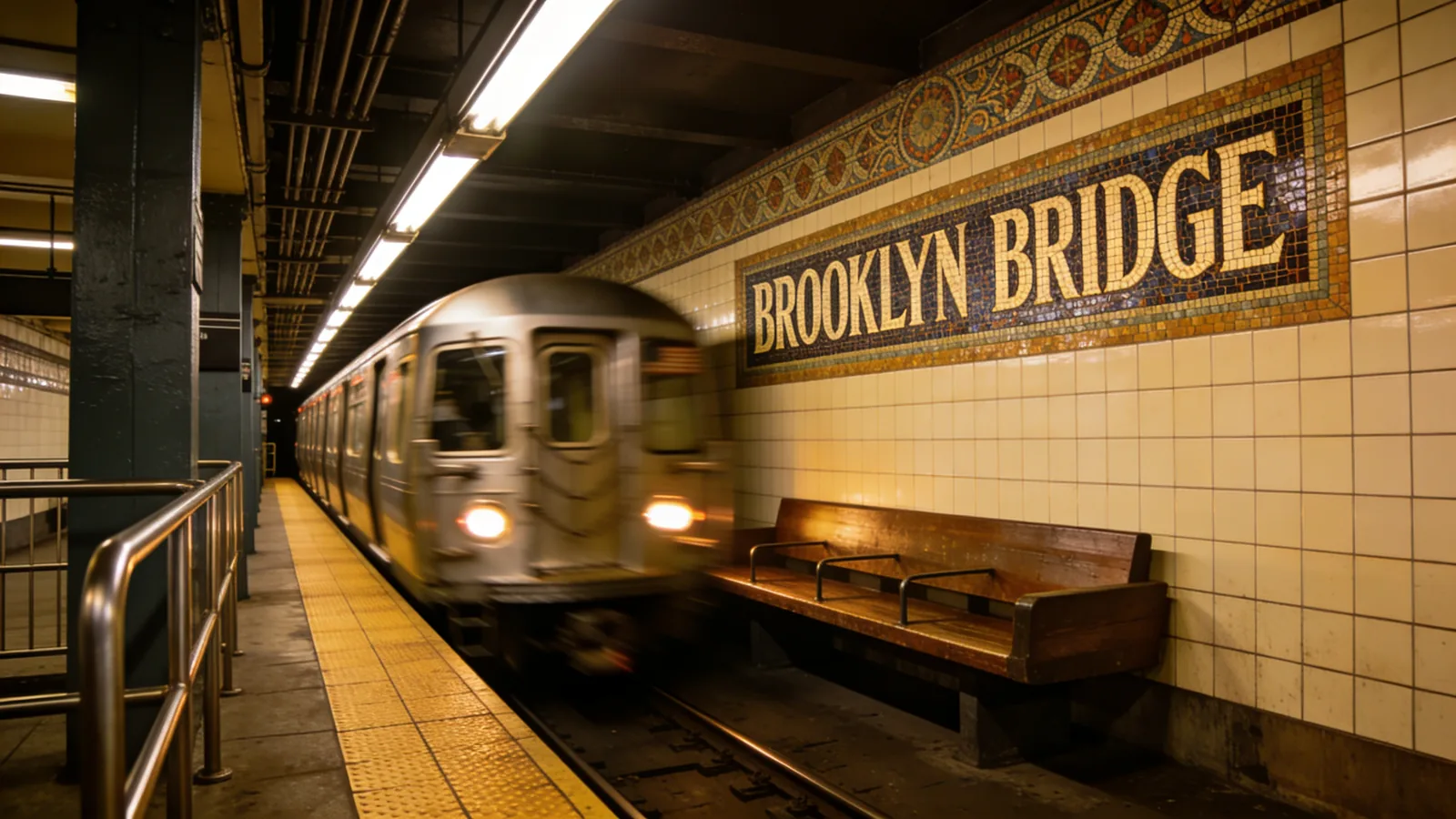
- Iconic NYC mosaic tile station signs at every stop — a small art-history layer for observant visitors
Difference 3 — Cost
Cost is the most visitor-relevant Hop On Hop Off vs NYC Subway difference. The subway is dramatically cheaper.
NYC Subway cost (per MTA / OMNY)
- $2.90 per ride (any distance)
- $34 weekly cap (Monday-Sunday) — 13+ rides become effectively free after the cap
- Free transfers between subway-and-bus within 2 hours
- No advance ticket purchase needed — tap and ride with contactless bank card, phone, or OMNY card
Hop On Hop Off cost
- $50-$80 per 24-hour pass (verify operator)
- $70-$120 per 48-hour pass
- $90-$150 per 72-hour pass
- Multi-day passes spread cost but you only ride the bus, not the subway, for the bus loop coverage
Honest math
For a 4-day NYC trip with daily 4-6 subway rides: ~$50 total subway cost vs ~$100-$200 for hop on hop off pass. The subway is dramatically cheaper for the equivalent transit volume. But hop on hop off includes the narration that costs $0 of subway value.
Difference 4 — Accessibility
Per MTA's official accessibility status, only ~25% of subway stations are ADA-accessible — the rest involve stairs from street to platform. Hop on hop off operators run wheelchair-accessible buses on the lower deck with operator-assisted boarding.
NYC Subway accessibility limits
- ~25% of 472 stations have elevators (ADA-accessible)
- ~75% require stairs from street level — physically inaccessible for wheelchair users, strollers can be difficult, anyone with knee/hip issues
- Elevator outages happen and are reported on mta.info but cause real disruption
- Even accessible stations may have elevators that connect only some platforms
Hop On Hop Off accessibility
- Both Big Bus and TopView run wheelchair-accessible buses (lower deck)
- Operator-assisted boarding with wheelchair ramps
- Strollers easier to manage than subway stairs
- The upper deck remains stairs-only but the lower-deck experience is fully accessible
Difference 5 — Geographic coverage
The Hop On Hop Off vs NYC Subway geographic comparison flips depending on visitor priority.
NYC Subway coverage
- 472 stations across all 5 boroughs
- 24/7 service every line, every day
- Reaches outer boroughs that buses don't cover (Bronx, Queens, Staten Island via Staten Island Railway)
- Connects to airports (Queens to JFK via E + AirTrain; LGA via several connections)
Hop On Hop Off coverage
- 3 loops typical: Downtown Manhattan, Uptown Manhattan, Brooklyn
- ~30+ stops total, mostly tourist-facing
- Does not reach Queens, Bronx, Staten Island
- Operating hours typically 9 a.m.-7 p.m.; no overnight service
Using both Hop On Hop Off vs NYC Subway in one NYC trip
The smart NYC trip uses both. Standard pattern for a 3-5 day trip:
Day 1 (orientation day)
- Hop on hop off Downtown + Uptown loops for orientation
- Subway for the airport-to-hotel transfer and any specific evening dinner reservation
Day 2-5 (depth days)
- Subway for all point-to-point transit (Times Square → Brooklyn Bridge → Wall Street → Statue of Liberty ferry)
- Walking pace within each neighborhood you visit
- Hop on hop off optional for one specific stop you missed Day 1
Honest takeaway
Most experienced NYC visitors stop using hop on hop off after Day 1 and switch to subway + walking. First-time visitors benefit from the Day 1 hop on hop off orientation that lets them then use the subway intelligently for the rest of the trip.
OMNY + subway basics for visitors
Per MTA, OMNY is now the standard NYC Subway fare system. Visitors should know:
- How to pay: tap your contactless bank card (Visa, MasterCard, Amex), phone (Apple Pay, Google Pay, Samsung Pay), or OMNY card at the turnstile reader
- How much: $2.90 per ride; capped at $34/week (Monday-Sunday)
- OMNY card: physical card for $1 at vending machines; useful if you don't have contactless payment
- Reduced fare: available for seniors 65+, ADA-eligible riders, low-income; verify on mta.info
- Family rides: 3 children under 44 inches tall ride free with paying adult
- Train delays: real-time updates at mta.info or via the MYmta app
Best subway tips for first-time NYC visitors
- Download the official MYmta app for real-time service status
- Take a screenshot of the subway map (saves data when underground)
- Sit on the inside of the platform — closer to the train, faster boarding
- Don't stand near closing doors — they don't bounce open like elevator doors
- Express trains skip stops (1 train is local; 2/3 are express on the same line). Confirm before boarding.
- Weekend service changes are common — check mta.info before leaving the hotel

Weather + safety realities for Hop On Hop Off vs NYC Subway
The Hop On Hop Off vs NYC Subway weather and safety calculus changes by season and time of day.
Summer (June-August)
- Subway: stations can be 95-105°F due to underground heat; the trains themselves are well-air-conditioned. Best to wait near the train approach point rather than standing on hot platforms.
- Hop on hop off: upper deck open air can be 90+ in afternoon sun; lower deck AC; bring sunscreen + hat for upper deck.
Winter (December-March)
- Subway: warm refuge from cold streets; trains are heated.
- Hop on hop off: lower deck heated; upper deck brutal in January wind — for visitors who haven't dressed appropriately, the upper deck experience becomes a 10-minute photo stop instead of an extended ride.
Late-night safety
- Subway after 11 p.m.: ride in the conductor's car (middle of the train); avoid empty cars; the system is generally safe but lower-density at night.
- Hop on hop off after 7 p.m.: mostly not operating; some operators run dedicated "Night Tour" products that are different from the day pass.
Specific Hop On Hop Off vs NYC Subway route decisions
Some NYC travel routes are clearly better via subway; others clearly better via hop on hop off. Match the choice to the specific trip leg:
Times Square to Empire State Building (5 blocks)
- Subway: wasteful — only 5 blocks. Use the walk-time (10 min).
- Walk: 10 min through Fifth Avenue. Wins on speed, scenery, exercise.
- Hop on hop off: not direct; involves a connecting loop.
Times Square to Battery Park (3 miles)
- Subway 1 train: 15-20 min direct.
- Walk: 60-75 min — too long for most visitors.
- Hop on hop off Downtown loop: 60-90 min depending on traffic — slow but scenic.
- Verdict: Subway for the transit; hop on hop off if you also want to see what's between.
Manhattan to Brooklyn Bridge / DUMBO (cross-river)
- Subway 4/5 to Brooklyn Bridge-City Hall: 20-30 min from Midtown
- Walk the Brooklyn Bridge: 30-40 min crossing time, free, photogenic
- Hop on hop off Brooklyn loop: covers DUMBO but on bus loop timing (~60 min from Manhattan)
- Verdict: Subway for fast cross-river; walk the bridge for the iconic moment; bus only if Brooklyn loop fits your day shape.
Manhattan to JFK / LGA / EWR airports
- JFK: Subway E + AirTrain (~60-75 min, $11.30 total)
- LGA: Subway 7 + Q70 bus or subway-to-LIRR (~45-60 min)
- EWR: NJ Transit + AirTrain (~45 min)
- Hop on hop off does NOT serve airports
Late evening Theater District to hotel
- Subway: 24/7 service, $2.90, walking-distance from most Theater District hotels
- Hop on hop off: doesn't run after ~7 p.m.
- Taxi/Uber: $15-$30 typical Midtown short-distance fare
- Verdict: Subway wins unless you're tired/raining/late-night safety preference for car
Hop On Hop Off vs NYC Subway cost analysis for typical trips
The Hop On Hop Off vs NYC Subway cost gap is significant but easy to miscalculate. The right way to compare: what you spend per useful transit move, not the headline pass price.
Subway cost math for a 5-day NYC trip
- Typical first-time visitor: 4-6 subway rides per day × 5 days = 20-30 rides total
- OMNY weekly cap: $34 (Monday-Sunday) — caps after 12 rides, every ride after is free that week
- Effective per-ride cost across the trip: $1.13 to $1.70
- Total subway cost for the trip: ~$34 if the trip falls within one Monday-Sunday window
Hop on hop off cost math for the same trip
- 1-day pass: covers Day 1 orientation only — visitor switches to subway Day 2-5
- 2-day pass: covers Day 1-2; visitor on subway Day 3-5
- 3-day pass: rarely worth it because most visitors stop riding by Day 3
- Headline price varies by operator; the value erodes if visitor only rides one or two days
Honest takeaway
Hop on hop off makes financial sense if you use it consistently for 1-2 full orientation days. For Day 3-5, subway wins on every metric. The optimal Hop On Hop Off vs NYC Subway budget: 1-day hop on hop off pass + subway for the rest of the trip.
FAQ
Quick answers to the most-asked Hop On Hop Off vs NYC Subway questions.
Is the NYC Subway safe for tourists?
Yes. Per NYC tourism data and visitor surveys, the subway is one of the most heavily-used public transit systems in America with millions of daily riders. Common-sense safety applies (don't flash valuables, stay aware of surroundings, use cars near operator at late night) but it's not a tourist-specific risk zone.
Should I get a hop on hop off pass if I plan to use the subway?
For Day 1 orientation, yes. For the rest of your trip, no — the subway + walking covers what you'd use the bus for at a fraction of the cost. Most visitors find Day 1 hop on hop off + subway-for-rest-of-trip the right balance.
How do I pay for the NYC Subway?
OMNY tap-and-go: contactless bank card (Visa/MC/Amex), phone (Apple/Google/Samsung Pay), or OMNY card at the turnstile reader. No advance ticket purchase needed.
Is the NYC Subway wheelchair accessible?
Only ~25% of stations per MTA. For wheelchair users, hop on hop off (or accessible bus + taxi/Uber) is more reliable than subway for NYC trips.
Does hop on hop off run 24/7?
No. Operators typically run 9 a.m.-7 p.m. with reduced service in evening. NYC Subway runs 24/7.
Which is better for traveling with kids?
Hop on hop off is more comfortable (seated, AC, rest between stops). NYC Subway is faster but kids may struggle with stairs/crowds. For NYC trips with kids under 8, hop on hop off Day 1 + careful subway use (accessible stations only) for the rest is the right balance.
What about late-night transit?
NYC Subway 24/7. Hop on hop off stops by ~7 p.m. For late-night transit (after Broadway show, dinner, observation deck), the subway is your only option.
Can I see the same sights from the subway?
No. The subway is mostly underground. The bus's value is the open-top deck view of the city, which the subway can't deliver. If sightseeing-while-traveling matters to you, hop on hop off wins on that single criterion.

Subway + walking + guided depth.
The NYC Icons Experience uses subway for transit + walking pace within neighborhoods + a real guide for depth. Combines all the best parts of Hop On Hop Off vs NYC Subway without committing to either.
📞 646-531-0647 · ✉ Contact us
Ready to book?
- Hop On and Hop Off Bus — the See City Tours bus product covered in this comparison
- NYC Icons Experience — guided alternative using subway + walking
- Top of the Rock · Empire State Building — observation deck stops the subway gets you to fast
- Help with subway-vs-bus strategy? Message us via our contact page · 646-531-0647 · /contact/
Sources
- MTA (official): mta.info
- OMNY (official): omny.info
- MTA accessibility: mta.info/accessibility
- Big Bus New York: bigbustours.com/new-york
- TopView Sightseeing: topviewnyc.com
Last updated 2026-05-25. Hop On Hop Off vs NYC Subway — facts verified against MTA primary sources + operator official sites.